
.jpg)
.png)
Here's what typically happens: companies hire an SEO agency, traffic goes up, demos don't.
I've observed this pattern with hundreds of B2B marketers. The agency shows beautiful upward-trending graphs. Your sales team asks where the qualified leads are. You're stuck in a 12-month contract watching the wrong numbers increase.
The core issue isn't incompetence, it's misalignment.
Most agencies operate with a 2019 playbook in a fundamentally different search landscape.
What do I mean by this?
They're chasing traffic when 65% of searches end without a click. They're targeting "what is [your category]?" when ChatGPT has 400 million weekly users getting those answers without visiting websites.
If you're looking for agencies that actually focus on revenue, I've compiled a list of B2B SEO agencies worth considering.
But first, here are six patterns that signal an agency hasn't adapted (aka red flags), and what you should look for instead:
Red flag #1: They can't connect their SEO work to revenue
The first red flag I see are agency presentations that focus on traffic increases and ranking improvements. Case studies showcase visitor growth but skip conversion data.
Look, traffic and rankings are relevant, but they're secondary. You're not investing in an agency to inflate traffic numbers. You want business outcomes, and SEO should drive revenue.
Here’s the question you should ask: can they show you one client where they connected SEO work to closed revenue?
Not "we increased traffic by 5x." Show me the booked demos or sign-ups. Show me which keywords correlated with actual deals.
Most agencies track rankings and traffic because that's what they can control and what's easy to report on. The sophisticated ones track what actually matters to your business.
Let me walk you through an example:
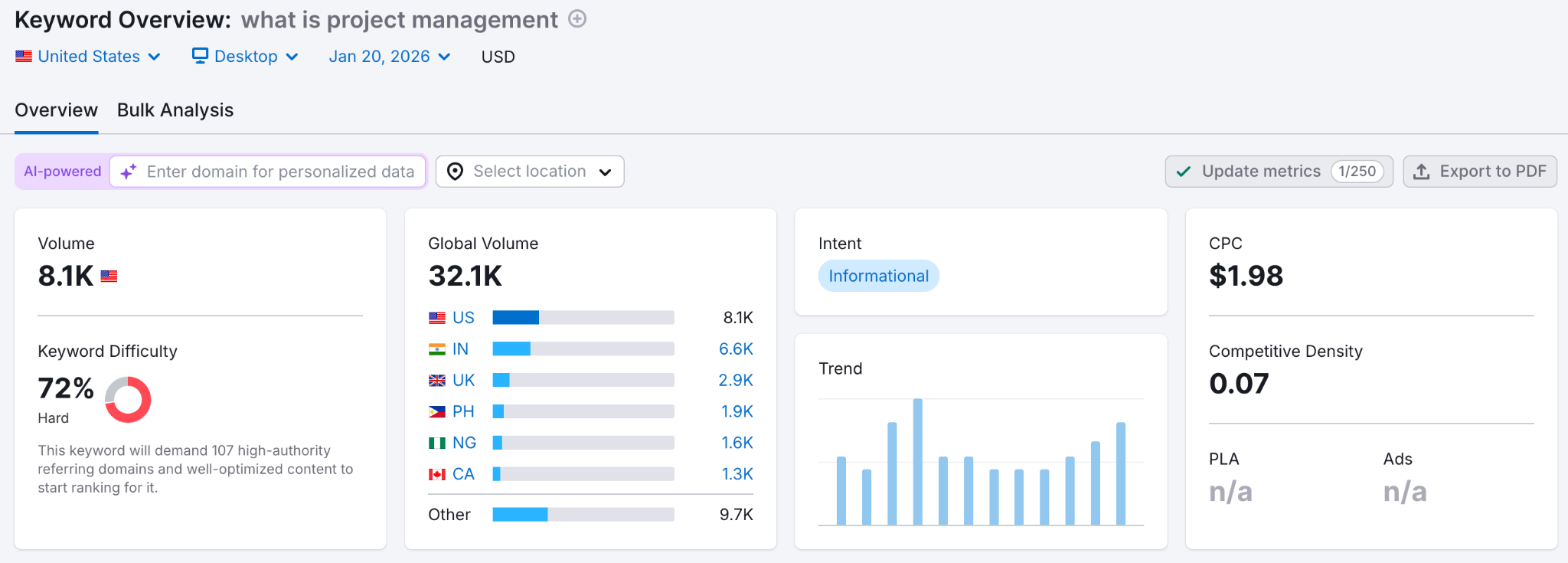
Broad keywords have more volume and make reports look impressive. "What is project management" gets 32,100 monthly searches globally. But that doesn’t mean you should allocate resources to rank for it, because you wont attract prospects that way. They're far more educated than that.
"Asana vs Monday for cross-departmental collaboration for distributed engineering teams" gets 50 searches per month.
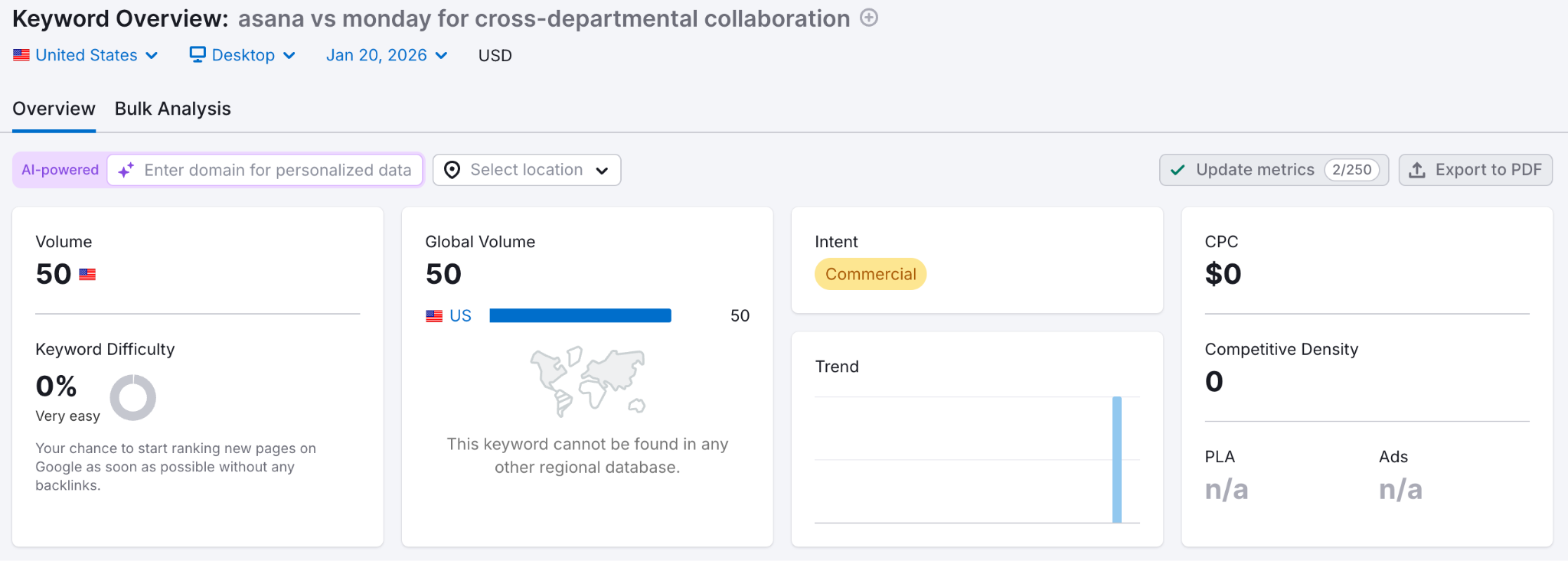
The first makes graphs go up. The second drives qualified pipeline.
On top of that, it has lower competition, which means you’ll rank and drive conversions faster.
So, how do you figure out whether or not a B2B SEO Agency focuses on revenue?
In your first conversation, sophisticated agencies should ask you:
- "What's your average contract value?"
- "How long is your typical sales cycle?"
- "What differentiates closed-won from closed-lost deals?"
- "Which competitors surface most in late-stage conversations?"
- "What does your sales team say about the leads marketing sends?"
If they jump straight to keyword research without understanding your customer, they're optimizing for metrics instead of outcomes.
Here’s what you should look for:
Ask: "Walk me through how you'd prioritize keywords for us. What would you target first and why?"
Strong answer: They explain a bottom-up approach, starting with comparison and solution-aware keywords. They mention analyzing your best customers to find patterns.
Weak answer: They focus on search volume and "low-hanging fruit" without asking about your business model.
For more on how B2B SaaS SEO differs from traditional SEO, read our guide.
Red flag #2: They don't talk to your sales team
The pattern I see, is that agency proposes a content calendar based entirely on keyword tools and competitor analysis. No mention of talking to your customer-facing teams.
Your sales and CS teams have information no keyword tool provides:
- The three objections that kill most deals
- Which competitor names surface in late-stage conversations
- The exact language prospects use when ready to buy
- Why customers choose you over alternatives (or vice versa)
Here’s a real example:
Our client Crono’s sales team kept hearing the same thing in demos: "We tried Mailshake but we need more than a cold email tool."
This was the number one reason prospects were choosing Crono instead of Mailshake. So we looked at the keyword "Mailshake alternatives", 140 monthly searches. Not massive, but these were people actively looking to switch.
We created a straightforward comparison article positioning Crono as the multi-channel alternative.
It ranks on position 1 and have been for 4 months straight - but that’s the easy part, what matters is that it generates a consistent flow of highly qualified leads every month.
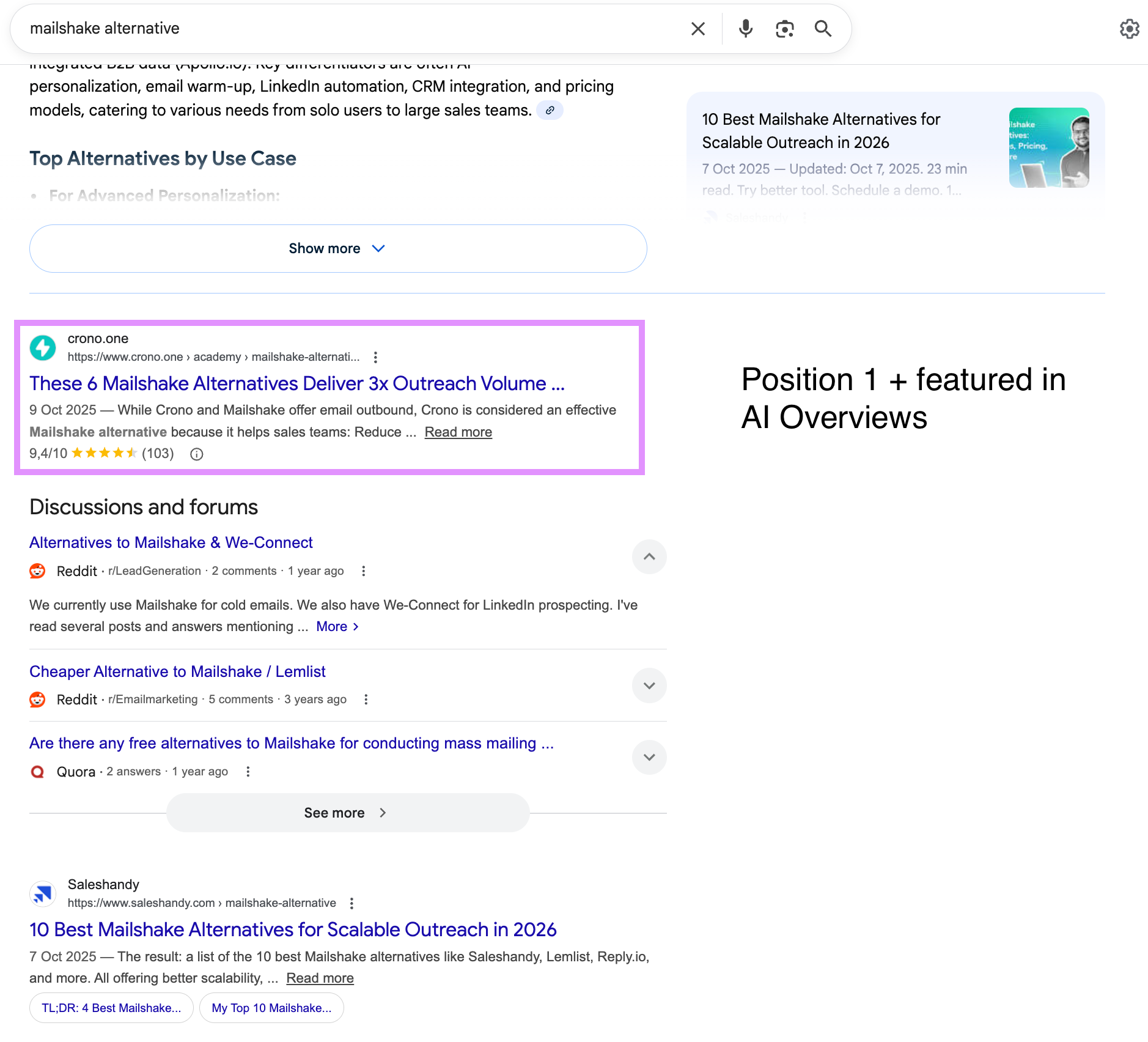
And, Crono appears in AI Overviews and ChatGPT recommends them for this query. We did the same for their other main competitors.
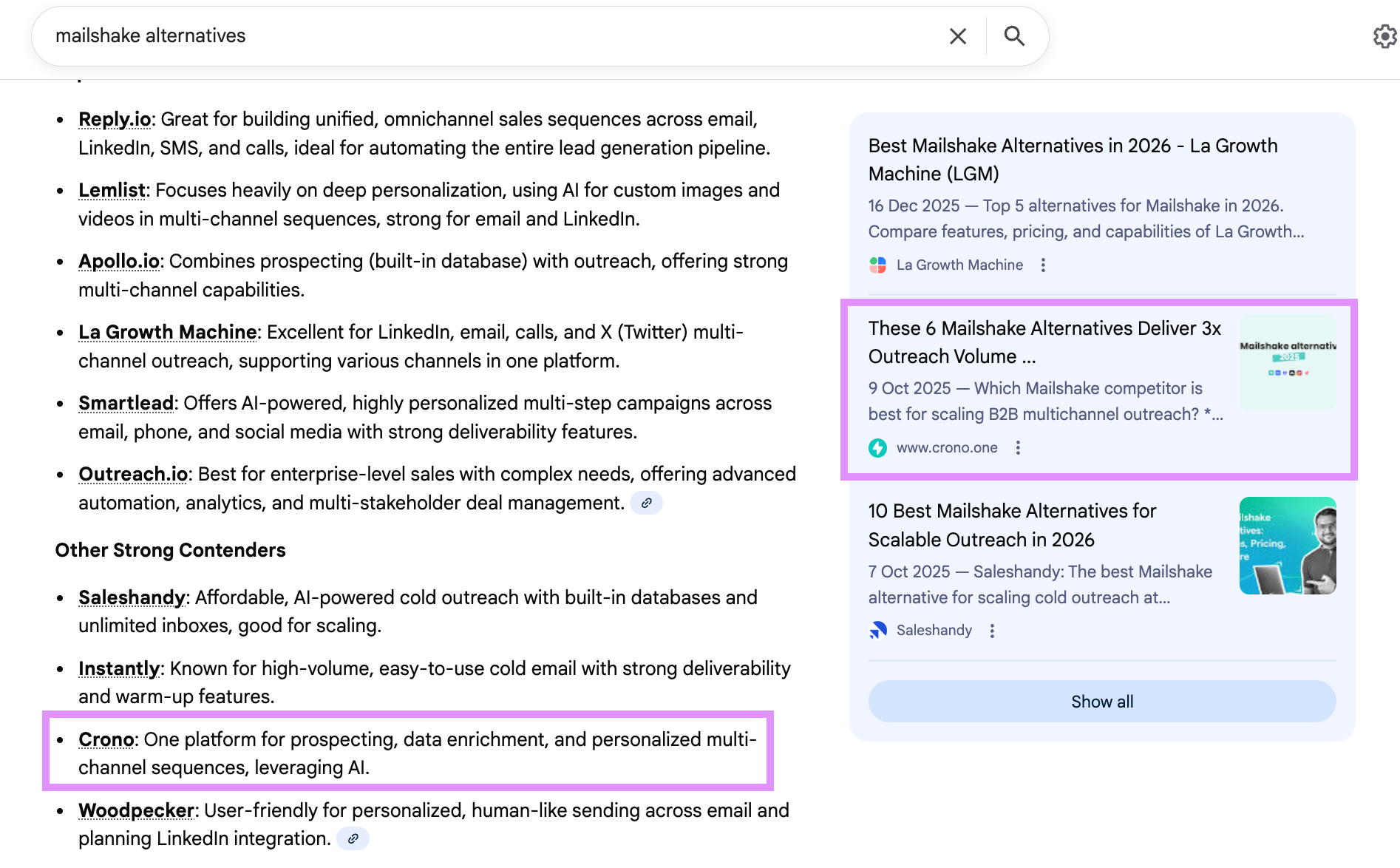
That content stream now drives some of their most qualified demos. The volume is modest, but the people finding it are already evaluating alternatives and ready to make a decision.
An agency that only runs keyword reports would have missed this entirely. They wouldn't have known what prospects actually say in demos. This is why talking to sales teams is the biggest marketing blind spot most agencies have.
I see this as a major red flag, and it’s what separates SEO that drives revenue from SEO that just inflates traffic.
The quickest way to tell what kind of B2B SEO agency you’re dealing with is simple.
Ask them: “What’s your process for understanding why we win and lose deals?”
If they’re revenue-focused, they’ll ask for access to sales call recordings, want to interview 3–5 reps, review win/loss analysis, and clearly explain how those customer insights shape the content strategy.
What you don’t want to hear is: “We’ll analyze your competitors and do keyword research” — with zero mention of talking to customers or the sales team.
Learn more about how customer interviews drive bottom-of-funnel SEO strategy.
Red Flag #3: They create generic content that could've been written by anyone
AI-generated content has been flooding the internet for the past two years, at this point, it’s hard to avoid. The good news is that Google doesn’t really care whether a human or a machine wrote the content. What it cares about is whether the article is actually valuable and meaningfully different.
Content is a big part of SEO. You want to make sure the agency you work with produces content you can proudly put your brand stamp on.
The red flag here is that many agencies spend far more time perfecting technical SEO audits than mastering content writing itself.
This is non-negotiable: read content the agency has written in your industry. The first two paragraphs will tell you everything you need to know.
If you see:
- "In today's digital landscape..."
- "As businesses navigate..."
- "[Your industry] is evolving faster than ever..."
You're reading content from someone who Googled the topic for 20 minutes, not someone who understands your space.
The content that works in 2026:
- Too specific for AI to generate without deep context
- Based on real experience, not surface-level research
- Uses language and examples from your actual industry
- Addresses nuanced problems requiring expertise
Red Flag #4: They lack a clear testing or experimentation framework
Here's what separates agencies that deliver consistent results from those that plateau: systematic experimentation. And if you’re speaking to an agency, and there’s no mention of how they test, measure, and improve. It’s a red flag.
Why does this matter?
SEO isn't static. What worked six months ago might not work today. Google updates algorithms. AI Overviews change which queries get clicks. Competitor content evolves. Without a testing framework, they’re operating on educated guesses. Each business needs its own strategy. What works for a B2B accounting software with established brand recognition won't work for a smaller company with less domain authority.
This is why a testing framework matters. You're not implementing someone else's winning playbook, you're systematically figuring out what works longterm for your specific market, product, and competition.
The right to ask is question: "How do you test? Show me your system and processes for testing."
In my experience, this is what good testing looks like:
Not "we'll try different things and see what works." That's randomness, not experimentation.
Good testing is:
- Clear hypotheses (we believe X will improve Y because Z)
- Tests one variable at a time
- Systematic results tracking
- Builds knowledge that informs future decisions
- Focuses on business metrics, not just SEO metrics
Here’s a simple example:
- This is a weak approach: "Let's publish 20 blog posts and see what ranks"
- This is a strong approach: "We're testing whether comparison content (X vs Y) converts better than solution content (How to solve Z). We'll create 3 of each type, match for keyword difficulty, track both ranking and conversion. Results inform whether we prioritize comparisons or how-to content in Q2."
Testing and experimenting is now more important than ever with the AI search shift:
With 65% of searches ending in zero-clicks and ChatGPT traffic doubling in early 2025, agencies need active experimentation to understand:
- Which content types get cited by AI vs. clicked through from Google
- How to optimize for visibility in ChatGPT and Perplexity
- What makes content too nuanced for AI to summarize
This requires testing, not assumptions.
Red Flag #5: They lock you into longterm contracts
This might be controversial, but I stand behind it: long contract lock-ins are a red flag.
If an agency needs a 6 or 12-month commitment at any price point, ask why. Quality work should prove value monthly.
Look, I understand the agency perspective. Long contracts mean predictable revenue and easier forecasting. It's comfortable.
But for you, it's risk. Your marketing budget shifts. Priorities change. You might need to reallocate resources in Q3 based on what happened in Q2. A 12-month lock-in removes that flexibility.
And the deeper issue is, if an agency needs to lock you in, it's often because they're not confident they can prove value month-over-month.
They're front-loading commitment because they know results take time—or might not come at all.
I've talked to marketers stuck in this exact situation. Six months in, results aren't there. But they're locked in for another six months while the agency coasts and collects checks. That's a terrible position to be in, and it's avoidable.
My co-founder wrote an excellent LinkedIn post about it.
Now let’s look at the other alternative (which we do at Exceed):
Contract flexibility. Good agencies offer:
- Rolling flexible 30-days contract
- Clear exit clauses with no more than 3-4 weeks notice period
- Monthly value demonstration
Why? Confidence. If they're delivering results, you won't want to leave. If they're not, you shouldn't be trapped.
Here’s how you find out:
Simply ask: "What's included in your monthly fee and what's your minimum commitment?"
Strong answer: Itemized breakdown of deliverables, clear explanation of cost drivers, 30-90 day terms with reasonable notice period.
Weak answer: Vague "full-service SEO" description without specifics, insistence on 12+ month contract, inability to explain what you're getting for the money. And uses “SEO takes time” as the reason.
Red Flag #6: The founder disappears after you sign
I've seen this pattern countless times. During sales, you speak with the founder or senior strategist. Everything feels right. You sign the contract.
Then collaboration starts, and you're handed off to a junior account manager.
The founder you spoke with? Nowhere to be found. This is how big agencies scale, they have to operate this way to service dozens of clients.
The problem is that all communication now flows through that junior account manager. You never speak directly with the strategist or writer working on your account.
For B2B SaaS SEO to work, you need responsive collaboration.
When your sales team surfaces a new objection pattern, or a competitor launches a feature you need to address, or your product roadmap shifts.
You can't wait 48 hours for email responses. You need direct communication with decision-makers.
Why does this matter?
The account manager translates your requests to the team, then translates their questions back to you. Information gets lost. Context disappears. Simple changes take days.
More importantly: the people doing the work never truly understand your business if they're not talking to you directly.
What good communication looks like:
Different agencies structure this differently, but effective patterns include:
- Shared Slack or Teams channel for quick questions
- Monthly strategy calls with the actual strategist (not just report reviews)
- Direct access for urgent items
- Collaborative tools (Notion, ClickUp, Trello) showing progress
And, you should be able to reach the person who can actually make decisions and answer strategic questions.
Those are the six red flags I see most often. There are others—overpromising guaranteed rankings, throwing around buzzwords like GEO and AEO without substance—but those warrant their own discussion, so I’ll leave it for another article.
To make your evaluation process simpler, here's a checklist you can use when vetting agencies:
Quick Evaluation Checklist
When evaluating agencies, use this checklist:
In the first conversation:
- Do they spend more time asking questions than pitching?
- Do they ask about your business model and customer journey?
- Do they want to understand what hasn't worked before?
- Do they ask how you measure marketing success?
About their expertise:
- What percentage of clients are in your industry or similar?
- Can they explain specific challenges in your business model?
- Do they understand your sales cycle and typical deal structure?
About their process:
- Can they explain exactly what happens in the first 90 days?
- How do they handle underperformance?
- Who makes strategy decisions?
- How often do they report and what's included?
The fit conversation:
- Are they willing to tell you if you're not a good fit?
- Do they turn down clients with unrealistic expectations?
- Do they say yes to everything or push back when appropriate?
Final Thoughts
SEO remains one of the highest-quality B2B lead sources when executed properly. But the approach matters more than ever.
Look for agencies that:
- Connect work to business outcomes
- Invest in understanding your market deeply
- Test and learn systematically
- Communicate transparently about timelines and expectations
- Don't require long-term lock-ins
The right agency becomes a genuine growth channel. The wrong one wastes 6-12 months and considerable resources.
This is worth getting right.
About Exceed SEO
We focus on B2B SaaS SEO that drives pipeline growth. Our clients include Willo, InviteDesk, Buildbite, Crono, ChaserHQ, Pelotech, and more.
Our approach: 30-day rolling contracts, sales team interviews inform strategy, bottom-funnel content prioritization, active testing and optimization.
If this makes sense for your business, reach out.
